


Why Professional Drone Services Cost More: Equipment, Skill, Risk & Value
In an age where advertising and social media play a major role in shaping how customers perceive a business, professional drone photography, videography and dynamic aerial video have evolved from premium extras into powerful marketing tools. High-quality drone content can influence how your brand is perceived, how effectively your business stands out online and how successfully your message reaches potential customers.
Yet one of the most common questions remains:
“Why Do Professional Drone Services Cost So Much?”
There is no single answer. The cost of professional drone production is determined by several factors working together. A serious production is a specialized service involving advanced technology, professional expertise, training, responsibility and continuous investment. Let’s look at what you are really paying for.
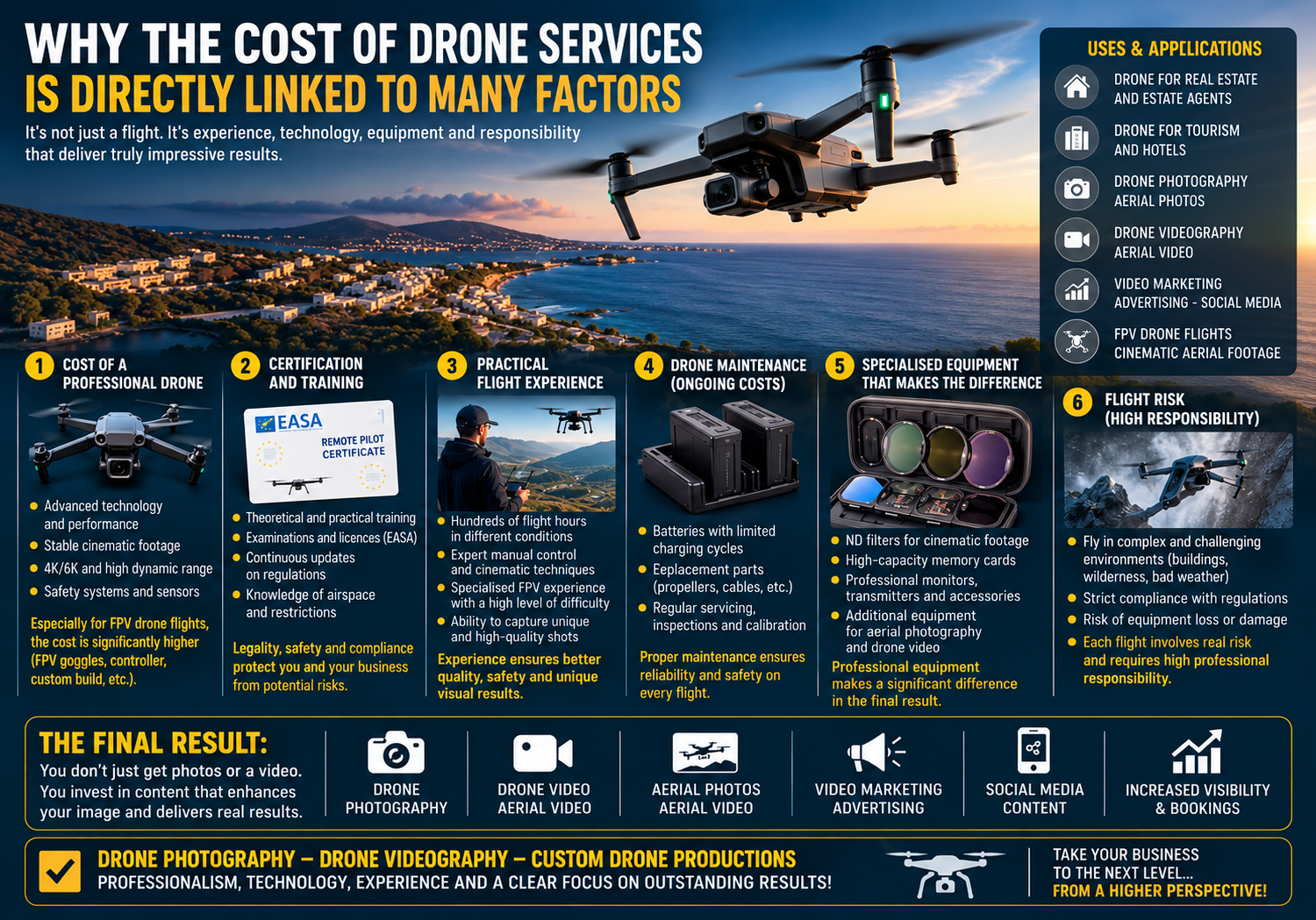
1. The Cost of Professional Drone Equipment
Every professional drone production begins with the equipment. And professional equipment represents a significant investment. A drone used for high-quality aerial photography and cinematic video is not simply a consumer gadget. It is an advanced imaging platform that may include:
high-resolution camera sensors
cinematic-grade gimbal stabilization
4K, 6K or higher-quality recording capabilities
advanced obstacle-detection systems
intelligent flight technology
professional colour profiles
high-performance transmission systems
When FPV drone flights are involved, the investment can become even greater. FPV filming requires a dedicated setup that may include:
FPV goggles
high-precision controllers
specialized aircraft
custom components
additional batteries
dedicated accessories and protection equipment
Before a single commercial flight takes place, a professional drone production company has already invested thousands of euros in technology and equipment.
2. Drone Pilot Certification: Training, Compliance and Responsibility
Professional drone filming is not simply about knowing how to move an aircraft through the air. It is also about operating responsibly and within the applicable aviation framework. Professional pilots must invest in appropriate training and certification according to the regulations relevant to their operations. This involves:
💰 training costs
💰 examination and certification costs
💰 continuous learning and professional development
💰 time invested in understanding regulations and airspace
A professional pilot needs to understand subjects such as:
flight regulations
operational safety
airspace restrictions
privacy considerations
risk management
responsible flight planning
Certification is therefore not merely a piece of paper. It represents a commitment to professionalism, safety and responsible operations.
3. Hundreds of Hours of Practice: Experience Has Value
The difference between someone who can fly a drone and someone who can deliver a professional cinematic result is experience. Creating smooth, controlled and visually compelling footage requires hundreds of hours of practice in both simulators and real-world environments. This becomes even more important with FPV drone cinematography. FPV flights may involve:
interior spaces
narrow passages
low-altitude flying
complex flight paths
close proximity to structures
rapidly changing environments
precise manual control
The difficulty is significantly higher than conventional automated drone flying. The pilot must simultaneously control the aircraft, anticipate the route and create visually attractive movement. What you are paying for, therefore, is not simply flight time. You are paying for:
experience, control, safety, precision and cinematic judgement.
4. Drone Maintenance: The Ongoing Cost Behind Every Flight
A professional drone is not a one-time purchase. It comes with constant operating and maintenance costs.
Batteries
Drone batteries are expensive and have a limited working lifespan. Their performance gradually decreases over time, meaning they must eventually be replaced. Professional operations also require multiple batteries in order to maintain efficient filming schedules. They must be:
charged correctly
stored safely
monitored for performance
replaced when necessary
Replacement Parts
Components such as:
propellers
cables
sensors
camera components
landing parts
protective elements
may require regular replacement.
Servicing & Calibration
Professional equipment must also be checked and maintained regularly. Aircraft, controllers, sensors and other systems may require:
inspection, servicing, firmware maintenance and calibration.
Proper maintenance helps ensure that every professional drone shoot can be carried out with the highest possible level of reliability and safety.
5. Accessories: The Details That Make the Difference
High-quality aerial photography and cinematic drone video often depend on much more than the aircraft itself. Professional accessories can significantly improve the final result.
ND Filters
Neutral Density filters are particularly important in cinematic drone filming. They help control the amount of light reaching the camera and allow more natural motion blur, contributing to a more professional and cinematic look. They can also provide greater creative control during post-production.
Additional Professional Equipment
A professional production setup may also include:
high-speed memory cards
carrying and protective cases
additional battery systems
professional monitors
wireless transmission accessories
protective equipment
replacement components
These details may not always be visible to the client, but they directly influence the reliability and quality of the production.
👉 All of this forms part of the real cost of professional drone services.
6. Flight Risk: The Invisible Cost
Every drone flight involves a degree of risk. With FPV filming, this risk can be even greater because the aircraft may operate:
near buildings
through narrow spaces
close to obstacles
indoors
at low altitude
in technically demanding environments
Collisions, equipment damage or even total loss of the aircraft are genuine operational risks. This is not theoretical. Professional drone equipment has significant financial value, and every complex flight requires judgement, preparation and risk management.
👉 When you hire a professional drone service, part of what you are paying for is the ability to manage that risk responsibly.
7. The Final Result: What You Are Really Buying
At the end of the day, you are not simply buying a collection of aerial photographs or a few minutes of drone footage. You are investing in high-quality visual content designed to promote your business. That content can become:
social media material
advertising content
website imagery
promotional video
real estate marketing
hotel or tourism content
brand-building material
sales support content
The real product is therefore not merely the flight. It is the final visual result and the commercial value it can create for your business.
The Price Reflects Much More Than Flight Time
A professional drone production combines:
equipment + certification + training + experience + maintenance + accessories + risk management + creative execution
That is why professional drone services cannot be judged simply by asking:
“How much does one hour of drone flying cost?”
The flight itself is only one part of the production. Behind it lies a complete professional infrastructure designed to deliver a reliable and high-quality result.
Conclusion
The price of professional drone photography, videography and FPV filming is not arbitrary. It reflects the investment behind the service:
professional equipment
pilot training and certification
hundreds of hours of practical experience
ongoing maintenance
specialized accessories
operational responsibility
the real risk involved in every flight
Most importantly, it reflects the quality and commercial value of the final production. Professional drone content, and especially FPV cinematography, should therefore not be viewed simply as another business expense.
It is an investment in the way your company is seen.
And when the production is planned and executed properly, that investment can continue delivering value long after the drone has landed.