


In today’s digital environment, where businesses rely heavily on social media and visual communication, drone photography and videography have become powerful marketing tools. Aerial photography, cinematic drone video and FPV productions are increasingly used by businesses that want to stand out through high-quality visual content.
However, one area that often creates confusion is copyright ownership and usage rights in the final edited video. This article explains how our standard production model works, why the finished video may include a watermark, and why a white-label version is offered as a separate service with additional usage rights.
1. The Value of Creation: It Is More Than Just Footage
Professional drone production is not simply about recording images from the air. The real value lies in the complete creative process. A finished drone video may involve:
concept development
creative direction
flight planning
shot selection
editing and post-production
colour grading
music
storytelling
branding
The aerial footage used in video marketing is therefore not simply a collection of files. It becomes part of a complete creative production designed for commercial communication, advertising and social media. This combination of technical expertise and creative decision-making is what transforms raw footage into a high-value marketing asset.
2. Copyright and the Final Edited Video
Original creative works are generally protected by copyright from the moment they are created, subject to the applicable legal framework and contractual arrangements. A professionally edited drone video may contain numerous creative elements, including:
camera movement, shot selection, sequencing, editing, colour treatment, music placement and narrative structure.
For this reason, the completed production is treated as a creative audiovisual work. Under our standard production terms, the client receives the agreed rights to use the final video, while the intellectual property and authorship rights associated with the production remain subject to the agreed licence and contract.
In other words, the client is normally purchasing usage rights, not automatically acquiring unrestricted ownership of every underlying production asset.
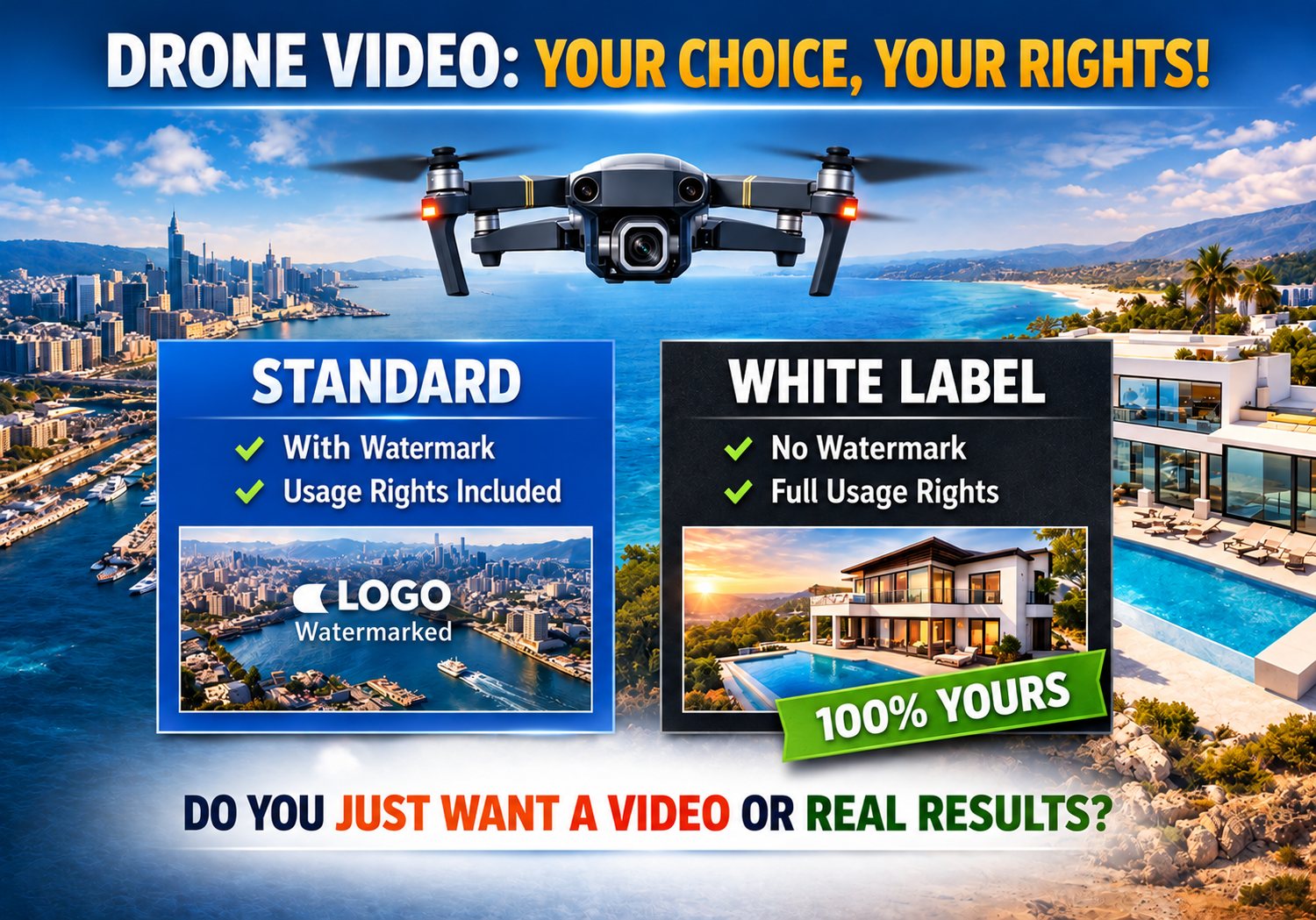
3. Why the Final Video Includes a Watermark
A watermark is not simply a decorative element. It serves as a visible form of attribution and protection. Under our standard delivery terms, a watermark can:
identify the producer of the work
discourage unauthorized copying
reduce misuse or redistribution
reinforce authorship
protect the commercial value of the production
This is particularly important in advertising and social media, where content can be copied, downloaded and redistributed very easily. The watermark effectively acts as a digital signature of the production.
4. Raw Footage vs the Final Production
It is important to distinguish between raw footage and the finished edited video. Raw footage is the original material captured during filming. The final production is created later, during post-production, when the best shots are selected and combined into a coherent visual story. This process may include:
shot selection, sequencing, colour correction, colour grading, sound and music, branding, transitions, visual effects
Under our standard production policy, raw footage is not automatically included in the final delivery. The same applies to unrestricted rights over the final production. Any transfer of raw material or additional usage rights must therefore be specifically agreed in advance.
This distinction is important because the real commercial value of professional production lies not only in the footage itself, but also in the way that footage is selected, edited and transformed into a finished marketing product.
5. What Is a White-Label Version?
A white-label version is a version of the final video delivered without our visible watermark or branding. This allows the client to use the production more seamlessly within their own brand identity. A white-label video can be particularly useful for:
websites
social media
advertising campaigns
corporate presentations
real estate marketing
hotel and tourism promotion
digital marketing campaigns
However, white-label delivery should not be understood as simply “removing a logo.” It represents a different commercial arrangement.
6. Why White-Label Delivery Costs More
A white-label production provides greater freedom to the client. It may involve broader usage permissions and removes the visible attribution that would otherwise identify the production company. This increases the commercial value of the content for the client. For that reason, white-label delivery may carry an additional fee. The additional cost reflects factors such as:
broader commercial use, increased branding flexibility, reduced producer visibility and the greater commercial value of unbranded content.
7. Why White Label Can Be a Strategic Investment
For businesses investing seriously in video marketing, white-label content can be strategically valuable. When all visible branding belongs exclusively to the client, the video integrates more naturally with the company’s existing visual identity. This is particularly important for businesses that want to use the content across:
websites, paid advertising, social media, digital campaigns and branded presentations.
A clean, unbranded production allows the content to become part of the client’s own communication ecosystem.
8. The Real Value of Professional Drone Production
Professional drone production is not simply a technical service. It is a creative and commercial investment. The quality of cinematic drone footage and FPV flights can directly influence:
brand perception
customer confidence
audience engagement
advertising effectiveness
overall professional image
High-quality visual content can help a business communicate at a much higher level than ordinary footage. This is why professional production should be evaluated not only by the time spent filming, but by the expertise, creative direction, equipment, editing and commercial value of the finished result.
9. Why Intellectual Property Should Be Respected
Respect for intellectual property is a fundamental part of a professional collaboration. A serious production involves investment in:
equipment, certification, training, flight experience, editing expertise, production time and creative development.
The final result should therefore not be treated as simply another downloadable file. Professional drone photography, videography and FPV cinematography are specialized creative services. Owning a drone and being able to fly it is very different from being able to plan, film, edit and deliver a professional commercial production.
The difference becomes particularly clear when the final content is intended to represent a business, property or brand publicly.
10. Clear Terms Protect Both Sides
The best way to avoid misunderstandings is to define the terms of the production clearly from the beginning. A professional agreement should clarify matters such as:
what content will be delivered
whether raw footage is included
whether the final video contains a watermark
what usage rights are granted
whether white-label delivery is required
whether additional licensing applies
how the content may be used commercially
Clear terms protect both the producer and the client and create a more professional working relationship.
Conclusion
A professional drone video is not simply a video file. It is the result of a complete creative process involving planning, cinematography, FPV or cinematic flight techniques, editing, colour grading, storytelling and branding.
Under our standard production model, the watermark helps protect and identify the work, while the client receives the agreed rights to use the finished production.
A white-label version, on the other hand, provides greater branding flexibility and commercial freedom and is therefore offered as a separate, higher-value service.
In a digital world dominated by video, advertising and social media, understanding the value of intellectual property and usage rights is essential. High-quality content delivers the greatest value when it is supported by:
professional production, clear agreements and respect for the creative work behind it.