


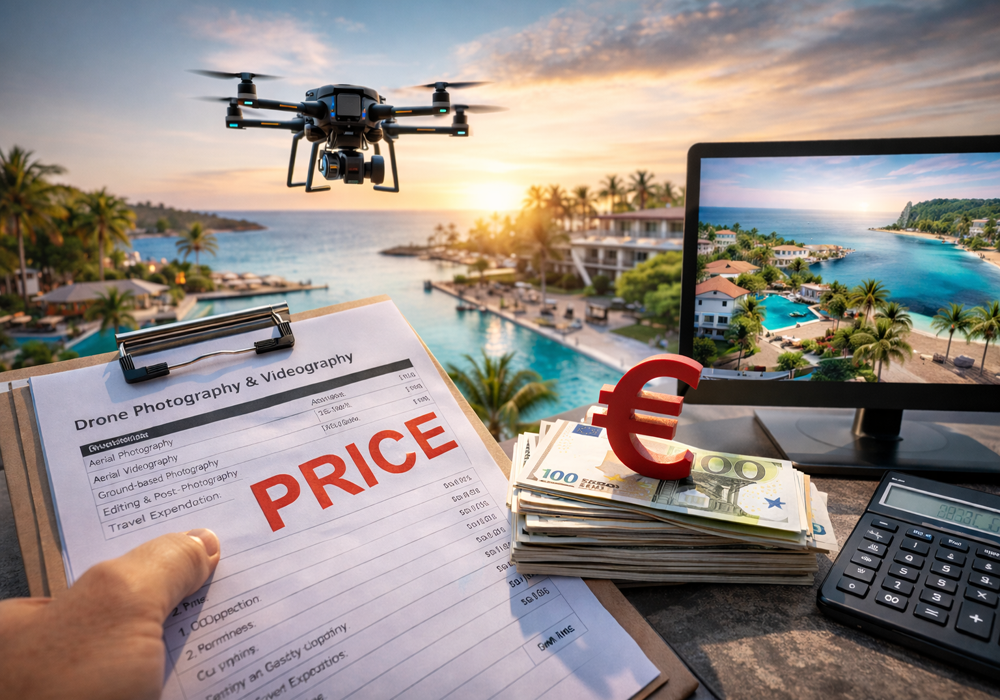
Professional drone photography and videography have become essential tools for businesses operating in sectors such as real estate, tourism, hospitality, commercial property and video marketing. Drone content is no longer simply a premium extra. For businesses that want to stand out in an increasingly competitive market, high-quality aerial imagery and video can be a valuable investment in visibility, branding and sales.
However, there is no single fixed price for aerial photography, drone videography or FPV drone production. The final cost depends on several factors, from the complexity of the project and the equipment required to filming conditions, post-production and licensing requirements.
Below, we look at the main factors that determine the price of a professional drone production.
1. Type of Project and Intended Use
One of the most important factors affecting the price is the purpose of the production. A simple set of aerial photographs for private use will naturally have different requirements from a commercial video created as part of a professional marketing campaign. For example, a small drone photography project for personal use may require relatively limited shooting and editing.
By contrast, a real estate drone production may involve carefully planned shots, creative direction, interior and exterior filming and professional editing. Likewise, a project for hotels, resorts or tourism businesses may require premium visual quality, storytelling and a combination of aerial, FPV and ground-based footage.
Commercial content generally carries greater production requirements because it is created to support the client’s marketing, brand image and commercial objectives.
2. Production Time and Complexity
The duration and complexity of the shoot have a direct impact on pricing.
A project completed within an hour cannot be priced in the same way as a full-day production involving multiple locations and different filming conditions.
Important factors include:
number of filming locations
number and complexity of shots
total flight time
sunrise, daytime or sunset filming
combination of aerial and ground footage
indoor and outdoor filming
cinematic drone shots
FPV drone flights
multiple takes and flight paths
A production involving a carefully planned storyline and numerous cinematic sequences naturally requires more preparation and filming time than a straightforward aerial photography session.
3. Drone Equipment and Technical Requirements
Not all drones, or productions, are the same. The quality and capabilities of the equipment play an important role in the final result.
Professional drone production may require features such as:
4K or higher-resolution video
RAW photography
advanced stabilization
obstacle detection
high dynamic range
low-light performance
professional colour profiles
specialized camera filters
A high-end promotional video for a hotel, commercial facility or luxury property requires professional equipment capable of delivering consistent and polished results. Specialized techniques such as Hyperlapse, tracking shots and FPV drone flights may also require additional equipment, preparation and piloting expertise, which can affect the overall price.
4. Editing and Post-Production
Capturing the footage is only the first part of the production process. Professional post-production often represents a significant proportion of the overall workload.
For drone video, post-production may include:
video editing
colour grading
music
transitions
motion graphics
visual effects
titles and branding
sound design
For aerial photography, processing may include:
retouching
HDR processing
colour correction
lighting adjustments
perspective and image optimization
Commercial video marketing projects generally require more detailed editing and creative post-production, which naturally increases the overall production cost. The final video is created not simply by flying the drone, but by carefully selecting and combining the strongest footage into a coherent visual story.
5. Permits, Regulations and Legal Requirements
Legal and responsible drone operations are an essential part of professional production. A professional operator must work in accordance with the applicable aviation regulations and have the appropriate pilot certification, registration and insurance required for the operation concerned.
Certain locations and flight scenarios may also require additional authorizations or permissions, particularly in:
urban environments
areas subject to flight restrictions
sensitive locations
certain tourist destinations
protected or controlled areas
Where additional procedures or permissions are required, the preparation involved can affect the overall cost. Professional compliance is not simply an administrative detail. It helps ensure that the production is carried out legally, responsibly and safely.
6. Location and Travel Costs
The location of the project also plays an important role in pricing. Filming in remote destinations may involve additional travel time and expenses, particularly for:
islands
remote areas
difficult-to-access locations
projects requiring accommodation
multiple filming locations
Urban environments may introduce a different set of challenges due to airspace restrictions, people, buildings and operational limitations. For example, filming a commercial building in the centre of a city involves very different planning from producing a drone video for a hotel on an island. For this reason, location is always considered when preparing an accurate quotation.
7. Experience and Professional Expertise
The experience of the drone pilot and production team is another important factor. Professional drone cinematography requires far more than the ability to operate an aircraft. An experienced professional brings knowledge of:
flight planning, composition, camera movement, aerial photography, cinematic videography, FPV flying, storytelling and post-production.
Experience helps reduce mistakes, improves efficiency during filming and allows more creative solutions to be developed for each project. This expertise has a direct impact on the quality and commercial value of the final result.
8. Combining Cinematic and FPV Drone Services
Many modern productions require more than one filming technique. For example, a project may combine:
cinematic aerial shots from altitude to establish the location and surrounding environment with FPV drone flights through interiors, outdoor areas and around the property itself. The cinematic drone provides scale and perspective. The FPV drone provides movement, immersion and a sense of exploration.
Combining the two creates a much more complete visual experience, although the additional planning, equipment and production time will naturally influence the overall cost.
9. Delivery Time
The required turnaround time can also affect pricing.
Standard delivery allows the production team sufficient time for footage selection, editing, colour correction and final quality control. An express delivery requires the editing process to be prioritised and completed within a much shorter timeframe.
This is particularly common in commercial video marketing projects connected to:
advertising campaigns
property launches
events
exhibitions
seasonal tourism campaigns
social media promotions
When urgent delivery is required, an additional cost may therefore apply.
10. Market Conditions and Project Requirements
Like most professional services, drone production is also influenced by the market. In areas or periods where demand is particularly high, production costs may increase due to availability, scheduling requirements and the level of quality expected by commercial clients. However, price should never be evaluated in isolation.
The most important consideration is what the final content is expected to achieve and the level of production required to achieve it.
Why There Is No Single Fixed Price
Two drone projects that may initially appear similar can involve completely different levels of work. One project may require:
a single location + basic aerial footage + minimal editing
while another may require:
multiple locations + cinematic drone shots + indoor FPV flights + ground footage + music + advanced editing + colour grading + several final formats.
For this reason, a professional quotation should be based on the actual requirements of the project, rather than a generic price list that treats every production in the same way.
Is Professional Drone Production Worth the Investment?
Professional drone photography and videography are not simply about producing attractive images. They create marketing assets that can be used across:
websites, social media, advertising campaigns, property listings, presentations, exhibitions and promotional material.
For sectors such as real estate and tourism, where customers often make decisions based heavily on visual presentation, the quality of the content can have a significant impact on how a property, hotel or business is perceived.
The same production can often be reused across multiple channels, extending its value far beyond the original filming day.
Conclusion
The cost of professional drone photography, cinematic videography and FPV drone filming depends on a combination of factors, including:
project complexity, filming time, equipment, location, professional expertise, legal requirements, post-production and delivery time.
Drone services should therefore not be viewed simply as the cost of capturing images from the air. A professional production is a complete visual communication and marketing service designed to present a business, property or destination at its best. This is particularly important in sectors such as real estate, hotels, tourism and commercial property, where visual presentation can play a decisive role in attracting attention and influencing customer decisions.
Ultimately, price reflects value.
In professional aerial photography, cinematic video and FPV production, that value is directly connected to the quality of the image your business presents to its audience.